

- Home
- About
- Art
- Interactive Map
- PERMANENT
- Temporary
- Upcoming
- PaintBox
- Conservation
- Image Use Request
- Artists
- CALL TO ARTISTS
- Propose Public Art
- Artist Space
- boston cultural council
- Artist Interviews
- Boston AIR
- Education
- News
- Contact
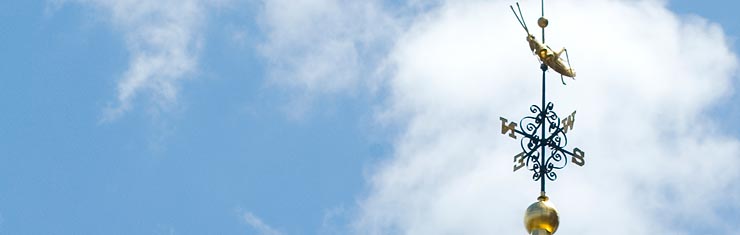


Faneuil Hall Grasshopper, 1742
Shem Drowne
Gilded copper with glass
Faneuil Hall Market
Shem Drowne
Gilded copper with glass
Faneuil Hall Market
Faneuil Hall is among the nation’s oldest and most important buildings. The building is often referred to as the Cradle of Liberty as it was the meeting place for the Sons of Liberty. Since 1742, the Georgian-style Great Hall has been used for public meetings and celebrations, and it continues to play a prominent role in Boston’s civic life today through debates on community issues, mayoral inaugurations and naturalization ceremonies for new Americans.
When the building needed to be rebuilt in 1762 after a fire, John Hancock organized the construction campaign. It was here, in 1772, that Samuel Adams incorporated the first Committee of Correspondence, thus establishing the first steps toward the American Revolution. A year later in 1773, the first meeting to protest the British tea tax occurred in the hall. Over many generations, Faneuil Hall has provided a platform for dialogue on critical social issues which have molded the nation, such as the abolishment of slavery, and the women’s suffrage, labor and civil rights movements. Famous orators who have spoken in the hall include Susan B. Anthony, Frederick Douglass, Lucy Stone, and John F. Kennedy.
The collection of art within the building commemorates some of the most important people, places and events that have shaped United States history. The largest painting, Webster Replying to Hayne, depicts Massachusetts Senator Webster debating with Senator Hayne on preserving the Union when the country was on the brink of the Civil War. Paintings and sculptures commemorate historical figures including John Quincy Adams, the sixth U.S. President; Charles Sumner, the abolitionist and U.S. Senator; and Lucy Stone, the suffragist and abolitionist. A portrait of the first U.S. Secretary of War, General Henry Knox, hangs at the front of the Great Hall, while a portrait of Wendell Phillips, orator and abolitionist, hangs at the back of the hall. The buildings itself, and its architectural features, are also a monument to colonial American culture, structural design and construction.
A Master Preservation Plan for the artwork in the Faneuil Hall collection was prepared in 2008. In accordance with this plan, the Boston Art Commission is currently undergoing a comprehensive effort to catalogue, restore, clean, repair and preserve all of the artwork located in Faneuil Hall, including twenty-three paintings and frames, seven sculptures, one clock, two engravings, two charcoal drawings, several pieces of historical furniture and historical architectural features. Funders of the project include Save America's Treasures and American Express.
Faneuil Hall is open daily, with free historical presentations every half hour. Faneuil Hall has served as an open-forum meeting hall and marketplace for more than 250 years and continues to provide a forum for debate on the most consequential issues of the day.
Mayor Menino Announces Lincoln Sketch Hung in Historic Faneuil Hall
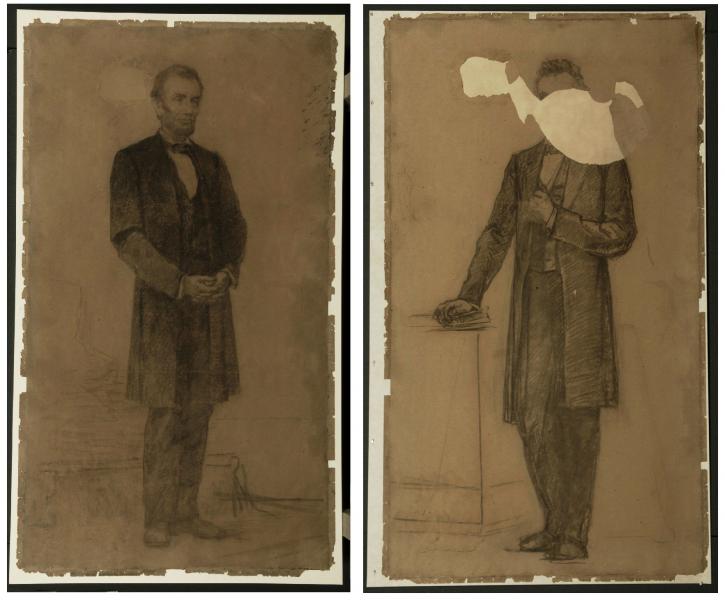
Two restored sketches, attributed to William Morris Hunt, of President Abraham Lincoln—studies for a lost painting—uncovered behind a portrait of Governor John Albion Andrew during Faneuil Hall conservation effort.
For years the sketches were hidden away behind the portrait of Governor Andrew at Faneuil Hall. Now Mayor Thomas Menino and the Boston Art Commission are pleased to unveil a high-resolution digital copy of the intact sketch to hang in Faneuil Hall. The original sketches, both of which require stable environmental conditions, have been taken on by the Museum of Fine Arts, Boston, on long-term loan. “This sketch of President Lincoln dating almost 150 years back is a unique historical treasure that Boston has the privilege of displaying in Faneuil Hall,” said Mayor Thomas M. Menino. “As time goes on, it becomes increasingly vital to preserve and share historical masterpieces such as these so that future generations can continue to celebrate our nation’s colorful past.”
Shortly after President Lincoln’s assassination, an oil painting was commissioned by the Boston firm Doll and Richards. In May of 1865, Mary Todd Lincoln sent a Black White House doorkeeper named Pendell to Boston. Being of comparable height to Lincoln and with the deceased President's clothes in hand, Pendell posed for the portrait. For unknown reasons Doll and Richards withdrew their commission, but Hunt was so pleased with how the piece was shaping up that he finished the painting on his own. After hearing about the dropped commission, Governor Andrew (a friend of the artist) attempted to purchase the piece, with the intention of displaying it in the State House. However, he was unsuccessful due to opposition from other legislators, and the painting was never displayed publicly. In the Summer Street Fire of 1872, Hunt's Mercantile Building studio and its contents were destroyed—including the Lincoln painting. Until now, all that remained of the historic piece was a small study of one of Hunt’s initial sketches, owned by the MFA.
In 1996, Peter Williams, a conservator hired by the Boston Art Commission to treat William Morris Hunt's portrait of Governor Andrew at Faneuil Hall, discovered an 86.25" H x 48.25" W charcoal sketch of Abraham Lincoln stretched behind the painting’s canvas. Attributed to William Morris Hunt, this sketch is believed to be a life-sized charcoal rendering for the Lincoln portrait lost to the fire. In 2011, the charcoal drawing was sent to the Northeast Document Conservation Center (NEDCC) in Andover, Massachusetts, for conservation treatment and digital imaging. The drawing had sustained considerable damage, including losses in several places and staining from the repair of the painting that covered it. There were tears throughout the drawing, including a large v-shaped break across the face. As conservators prepared the drawing for treatment by removing it from the stretcher, they discovered that the second sheet of brown paper underneath the first—originally thought to be a lining—was in fact a second sketch of Lincoln, this one in a different pose. There was extensive damage to the second sketch, with a loss that unfortunately included much of the face.
After conservation treatment, the first Lincoln portrait was digitized in NEDCC’s Imaging Studio, using a precision imaging table engineered to accommodate oversize materials. This technology allows true 1:1 object resolution and faithful color reproduction, as well as distortion-free imaging.
Special thanks go out to Save America’s Treasures and American Express, whose generous grants helped to fund the on-going Faneuil Hall conservation project. Visitors may view the newly installed artwork at Faneuil Hall Sunday – Saturday, 9am – 5pm, except during special events. For more information on the Faneuil Hall artwork conservation effort, please visit https://publicartboston.com/content/faneuil-hall-project.
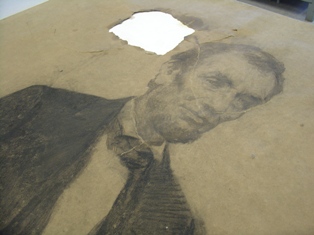
First Lincoln sketch before treatment by Northeast Document Conservation Center (NEDCC)
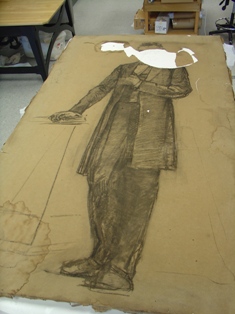
Second Lincoln sketch before treatment by NEDCC
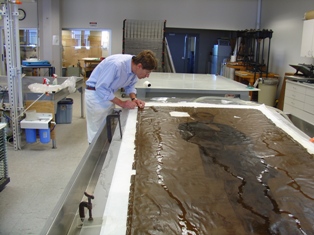
First Lincoln sketch during treatment by NEDCC
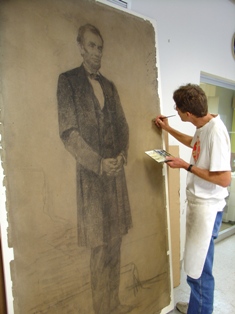
First Lincoln sketch during treatment by NEDCC
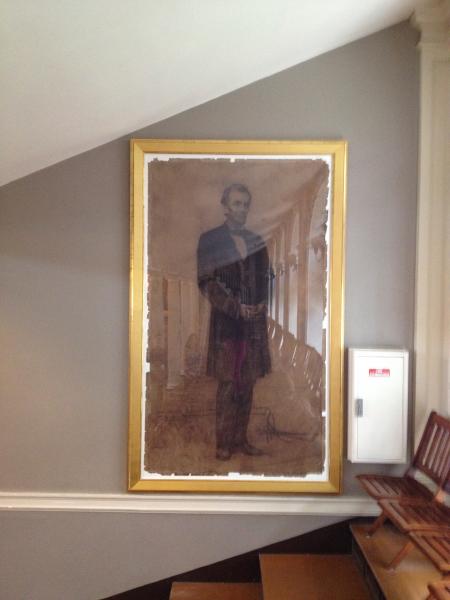
High-resolution digital copy of first Lincoln sketch in Faneuil Hall